Thomas Toast – January 31st, 2026 – Kitchener

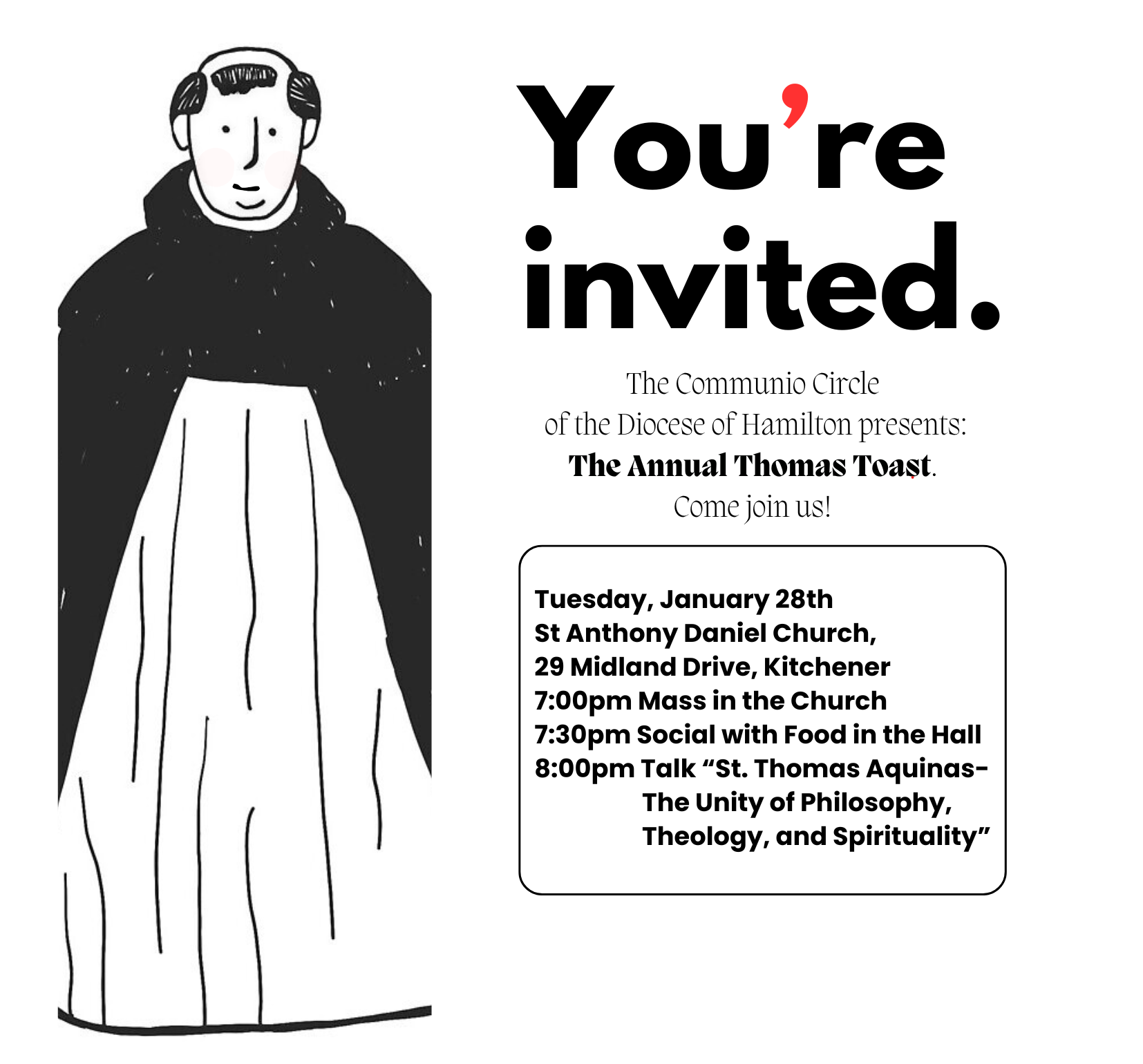
The Communio Circle of the Diocese of Hamilton invites you to our annual Thomas Toast event on Saturday, January 31st at St. Anthony Daniel Church, 29 Midland Dr, Kitchener, ON. Coffee will be available when the doors of the hall open at 9:30am. At 10:00am we will gather for Daytime Prayer and a talk by Dr. Peter Erb entitled: “Newman, Aquinas, and Pryzwara Revisited” followed by a toast to Thomas and a social until 12:00pm. For more information visit: communiohamiltondiocese.org, or contact Father Mark Morley: mmorley@communiohamiltondiocese.org, or Deacon Charles Fernandes: 519-923-0454.

Peter suggests reading this short article in preparation for his talk: Newman Today: After Kant and Aquinas.

Posted in Event | Leave a comment

Of Cicadas and Mayflies: Literary Education

You are invited to attend our next monthly meeting to be held on Friday, January 9th from 4:00pm to 5:30pm. We will be discussing “Of Cicadas and Mayflies: Literary Education” by James Matthew Wilson from the Summer 2025 issue entitled “Education” (Volume 52.2).

Here are excerpt from the Introduction to the issue:
In “Of Cicadas and Mayflies: Literary Education,” James Matthew Wilson asks how literature forms the soul. How can a work of fiction lead one into truth? Is it a mere aid for those not yet ready to face reality directly, or does it remain essential even at the highest stages of contemplation? Wilson answers that the literary—poiesis and mythos broadly understood—marks the full arc of education, beginning in an exitus and culminating in a reditus. Literature initiates the movement of the soul toward reality and fulfills it in the vision of form. Drawing on Plato, he shows that Socrates understood poetry as the opposite of sophistry: the latter “beneath reason,” using speech to obscure truth; the former “above reason,” revealing truth through image and symbol. Poetry presents to the soul what reason can reach only by slow ascent. It sends the soul forth toward truth, yet also remains the ground to which thought returns in rest—the beginning and the end of contemplation. For Wilson, this rhythm defines all genuine education. Works of art are not diversions from reality but encounters with it. They begin as responses to the world and become explorations of it, calling us not to abstraction but to dwell with the concrete form in its fullness, where the particular and the universal, the made and the real, meet. The work of art, he continues, is itself a mode of knowing. The act of making expresses a bodily, incarnate intelligence, and the finished work embodies a truth that can be contemplated. “The made work of fine art participates in an essential manner in the act of knowing,” he writes, “in the intellectual response that rational animals make to reality, to being as it gives itself.” Following Maritain, Wilson joins poetic and metaphysical knowledge: one seeks essences, the other encounters existence. From Augustine, he draws the insight that our patterns of making mirror the creative patterns of reality itself. Against Etienne Gilson, who sought to divide artistic fact from aesthetic reflection, Wilson insists that both belong to one movement of knowledge—the soul’s going forth and return within the order of being. Education, in its final sense, is therefore an act of contemplation, a “kind of aesthetic dwelling.” We should avoid dissolving form into abstractions; rather, we must see “into” it, until its unity discloses itself as the form of reality. Wilson ends with Richard Wilbur’s “Mayflies,” which captures for our author the experience of being wounded by the beautiful form contemplated to the one who has consented to receive being through that form’s fullness.

We will meet in the Kateri Room located at St. Michael’s Church, 240 Hemlock Street, Waterloo, Ontario. Use the east side parking lot and enter by the rear doors. Walk up the stairs. The Kateri Room is on your right before you enter the church proper.
Posted in Meeting | Leave a comment

The Symbolic Formation of the Heart

You are invited to attend our next monthly meeting to be held on Friday, December 12th from 4:00pm to 5:30pm.

We will be discussing “The Symbolic Formation of the Heart: On the Art of Conversion” by D.C. Schindler from the Summer 2025 issue entitled “Education” (Volume 52.2). The article can be downloaded from here.

Here are excerpt from the Introduction to the issue:
Education, Plato tells us, is the “art of turning around the whole soul.” In “The Symbolic Formation of the Heart: On the Art of Conversion,” D.C. Schindler takes up this claim and asks what it means for a human being to be reoriented toward reality in that comprehensive sense. Schindler interprets this reorientation not as a merely intellectual alteration, but as a transformation of the whole person: per se unum, body and soul. In this conversion, the soul, notes Schindler, can turn only around its own “center,” which Schindler locates in the heart. Following Aristotle and Aquinas, he describes the heart not as a mere metaphor for emotion but as the first mover of the living organism, the visible principle through which the soul gives life to the body. The heart is the meeting point between interior and exterior life, between knowing and loving. Against modern viewpoints that divide spirit from matter, Schindler insists that the heart is not simply a symbol of unity but a symbol that is itself unity: the joining together (sym-ballein) of body and soul, of the physical and the spiritual. If education, therefore, is to move the person as a whole, it must be directed toward this center. The heart, being symbolic by nature, is moved not by abstract information but by symbols, that is, by embodied forms that make meaning present. True pedagogy is not simply techniques, then, but formation, which takes places through ritual, imagination, and memory. These are habits that dispose the heart to recognize truth, goodness, and beauty as realities that are always-already given. Imagination, for Schindler, is the place where meaning becomes incarnate, where the soul learns to dwell with what it knows. Memory likewise belongs to the heart’s life: to “learn by heart” is to receive form into oneself, to interiorize the whole of something. All genuine teaching is thus symbolic: it communicates life through the embodied presence of the teacher, who becomes “a signpost, in his very person, that points to the truth, beauty, and goodness of reality.” The teacher, however, does not “produce” the conversion of the student, but enables him to receive it, as a “soul-shaking discovery of what was always-already there, always-already given—which is precisely what it means to receive the real as a gift.”

We will meet in the Kateri Room located at St. Michael’s Church, 240 Hemlock Street, Waterloo, Ontario. Use the east side parking lot and enter by the rear doors. Walk up the stairs. The Kateri Room is on your right before you enter the church proper.
Posted in Meeting | Leave a comment

Being Born into the Body of Christ

You are invited to attend our next monthly meeting to be held on Friday, November 14th from 4:00pm to 5:30pm.

We will be discussing “Being Born into the Body of Christ: Baptism and the Fruitful Form of the Church” by José Granados from the Spring 2025 issue entitled “Baptism” (Volume 52.1).

Here are excerpt from the Introduction to the issue:
In “Being Born into the Body of Christ: Baptism and the Fruitful Form of the Church,” José Granados responds to the claim that the “centrality of baptism requires a new reading of Lumen gentium,” put forth by Christoph Theobald. In Theobald’s assessment, Lumen gentium maintains too great of a distinction between the clergy and the laity, and in so doing, implies that the clergy have a greater degree of sanctity than the laity. Granados responds to Theobald’s concern by turning to the Biblical foundations of the sacrament of baptism. In particular he looks at the accounts of baptism in the eighth, ninth, and tenth chapters of the Book of Acts. Granados argues that the character bestowed in baptism bears within itself the entire hierarchical order of the Church, whether one is a layperson or a member of the clergy. In other words, the relationship between the laity and the clergy is not an addition brought in subsequent to a generic baptism, but is already entailed in and given by each person’s baptism, which makes us members of the Eucharistic Body of Christ. The dignity that it bestows is not neutral, nor does it affect us merely as individuals. Rather, it fits us for life in Christ and the Church. To this end baptism gives us “a new capacity to judge,” which is crucial for correctly understanding what is meant by the “sense of the faithful.”

We will meet in the Kateri Room located at St. Michael’s Church, 240 Hemlock Street, Waterloo, Ontario. Use the east side parking lot and enter by the rear doors. Walk up the stairs. The Kateri Room is on your right before you enter the church proper.
Posted in Meeting | Leave a comment

The Senses of Scripture and the Church’s Life

You are invited to attend our next monthly meeting to be held on Friday, October 10th from 4:00pm to 5:30pm. We will be discussing “The Senses of Scripture and the Church’s Life: Reading 2 Timothy with Henri de Lubac” by William M. Wright, IV from the Spring 2025 issue entitled “Baptism” (Volume 52.1).

Here are excerpt from the Introduction to the issue:
What is the meaning of Scripture, and how does one understand this meaning? Traditionally, the doctrine of the fourfold sense of Scripture provided the essential context for understanding God’s word rightly. In this doctrine, the literal sense and the spiritual senses interpenetrate one another, and each sheds light on the others. In “The Senses of Scripture and the Church’s Life: Reading 2 Timothy with Henri De Lubac,” William M. Wright IV examines and clarifies the meaning of each sense of Scripture and its place in the traditional method of read the Bible. Through the insights of de Lubac and an exegesis of the second letter of Paul to Timothy, Wright defends the use of the fourfold sense of Scripture, clarifying the terminology of this doctrine for those who wish to rediscover it today. If Sacred Scripture is the revelation of God, which is perfectly given in the person of Christ, then the meaning of Scripture only becomes truly accessible within the life of the Body of Christ, the Church. And becuase it is God’s disclosure of himself to those whom he has called into communion with him, this word becomes genuine Christian paideia: formation, and transformation, for those who read it as members of Christ’s Body.

We will meet in the Kateri Room located at St. Michael’s Church, 240 Hemlock Street, Waterloo, Ontario. Use the east side parking lot and enter by the rear doors. Walk up the stairs. The Kateri Room is on your right before you enter the church proper.
Posted in Meeting | Leave a comment

Funcken Poetry Day – Photo Gallery

Posted in Event, Photos | Leave a comment

Funcken Poetry Day

Sponsored by the Communio Circle of the Diocese of Hamilton
Saturday, September 20th, 2025 – 10:00am to 1:00pm
St. Agatha Catholic Church, 1839 Notre Dame Drive, St. Agatha, ON
You are invited to attend a poetry day in honour of Our Sorrowful Mother that will include praying for the repose of the soul of Father Eugene Funcken, C.R., and readings of some of his poems translated by our Communio Circle founder Peter Erb.

In response to a request for German-speaking priests to work in the newly created diocese of Hamilton Ontario, Eugene, only recently ordained (16 June, 1857) and a cleric, Edward Głowacki, were dispatched to the new mission in Canada, leaving Rome on 2 July, 1857. They arrived in the village and parish of St. Agatha on 14 August, 1857, where Eugene became the pastor, a position he would hold until his death in 1888. Fr. Eugene kept a Diary in which he describes his pastoral ministry; in addition to the ordinary duties such as celebrating Mass, hearing confessions, sick-calls occupied much of his time, because his parish was far-flung and travel in this rural area was sometimes difficult and even dangerous. Just two months after his arrival he wrote Fr. Jerome, “I would write more if I had more time but it is really quite impossible. For the last three weeks I have hardly had any rest because I have been to three different missions to celebrate Mass, hear confessions, baptize, preach and catechize; add to this the visits to the sick which sometimes take almost a full day due to the great distance.” . . . The people are very scattered here; the largest part of my parishioners live 7-10, sometimes even 17 miles away from the church. ”Fr. Eugene’s contributions to the life of the parish and the local church went beyond the ordinary. A lover of ceremony, he instituted celebrations of Feasts such as Corpus Christi which included much pageantry keeping with his desire to bring as much of the Roman liturgy to his parish as he could. His first concern, however, was the cemetery which he improved, refurbishing the walls, and building the small shrine to the Sorrowful Mother, which, though added to and improved over the years remains the only architectural testimony to Fr. Eugene.

On 12 July, 1888, he apparently suffered the first of series of strokes until on 19 July, in the words of his brother Luis, “An apoplexy, repeated, put an end to his days. . . . The mission lost a priest the likes of whom it will never have again.” In accordance with his wishes Eugene was buried in front of the cemetery chapel which he had built. Despite his admitted faults, Eugene remained faithful to his motto: “Man proposes, God disposes.”

Here is the schedule for the day:
9:30am Church Hall – Doors Open – Reception with Coffee
10:00am Welcome (Father Mariusz Durbajlo, Pastor)
10:05am Walk to the Shrine of Our Sorrowful Mother
10:20am Arrival at Shrine (Look around, relics, pray, …)
10:40 Office for the Dead – Morning Prayer (Father Mark Morley)
Devotion – The Seven Sorrows of the Blessed Virgin Mary
11:00am Funcken Poetry Reading (Peter Erb)
11:30am Walk to the Church Hall
11:45am Lunch
1:00pm END

For more information,
call Deacon Charles Fernandes: 519-923-0454
or e-mail Father Mark Morley
mmorley@communiohamiltondiocese.org
Posted in Event | Leave a comment

Baptism is First: Infant Baptism and the Sacramental Inversion

You are invited to attend our next monthly meeting to be held on Friday, September 12th from 4:00pm to 5:30pm.

We will be discussing “Baptism is First: Infant Baptism and the Sacramental Inversion” by Jonathan Martin Ciraulo from the Spring 2025 issue entitled “Baptism” (Volume 52.1). The article can be downloaded from here.
Here are excerpt from the Introduction to the issue:
In “Baptism is First: Infant Baptism and the Sacramental Inversion,” Jonathan Martin Ciraulo addresses the long disputed question of infant baptism. The question has both practical and theoretical implications for theology. It shapes how we understand the workings of grace and whether personal, conscious consent is necessary for grace to be efficacious. Ciraculo walks the reader through a history of the controversy, and then focuses on the question of infant baptism in the theology of Balthasar. For much of his life, Balthasar had acknowledged the validity of infant baptism, but expressed concerns with viewing it as normative. Towards the end of his life, however, Balthasar seemingly reverses his teaching, writing in Unless You Become Like This Child that it would be unjust to a child raised in the faith to be denied the grace of baptism. Ciraulo understands this later position as more consistent with Balthasar’s theology taken as a whole. He demonstrates this first by exploring the treatment of water in Sacred Scripture, which understands this ubiquitous element as something that is both present within creation, while also mysteriously preceding it and being indiciative of its eschatological perfection. In such a way, Ciraulo develops a theology of creation and of the sacraments (with which Balthasar would be in agreement) in which the sacraments are seen as the very reason for which the cosmos was created. This “sacramental inverson” turns our instinctive perspective on is head: rather than being an addition within time to creation, the sacraments are rather the perfection of creation intended by God from all eternity. Given this perspective, baptism’s justification is not that a person “chooses” to relate to God, but that baptism constitutes the perfection of the order into which a person is necessarily created.

We will meet in the Kateri Room located at St. Michael’s Church, 240 Hemlock Street, Waterloo, Ontario. Use the east side parking lot and enter by the rear doors. Walk up the stairs. The Kateri Room is on your right before you enter the church proper.
Posted in Meeting | Leave a comment

Possession in Detachment: The Fruitful Character of Virginity and the Virginal Character of Creativity

You are invited to attend our next monthly meeting to be held on Friday, August 8th from 4:00pm to 5:30pm.

We will be discussing “Possession in Detachment: The Fruitful Character of Virginity and the Virginal Character of Creativity” by Apolonio and Siobhan Latar from the Winter 2024 issue entitled “The Council of Nicaea (1,700 Years Later)” (Volume 51.4).

Here are excerpt from the Introduction to the issue:
“Possession in Detachment: The Fruitful Character of Virginity and the Virginal Character of Creativity” by Apolonio and Siobhan Latar relates Luigi Giussani’s and J. R. R. Tolkien’s theological and artistic perspectives on virginity. According to Giussani, the call to a virginal existence is universal. He defended this bold claim on the grounds that the ability to understand a thing depends on “an initial space or distance from it that enables one to affirm it first in its otherness.” Tolkien echoes this teaching in his explanation of the nature and task of an artist. He writes that, in order to portray anything truly, the artist must maintain a reverential distance from the reality in question. Distance allows the thing to be seen and appreciated in its entirety. For both Giussani and Tolkien, distance counterintuitively allows for a deeper understanding of and union with the thing loved.

We will meet in the Kateri Room located at St. Michael’s Church, 240 Hemlock Street, Waterloo, Ontario. Use the east side parking lot and enter by the rear doors. Walk up the stairs. The Kateri Room is on your right before you enter the church proper.
Posted in Meeting | Leave a comment

Athanasius, Nicaea, and the “Arian Controversy”

You are invited to attend our next monthly meeting to be held on Friday, July 11th from 4:00pm to 5:30pm.

We will be discussing “Athanasius, Nicaea, and the “Arian Controversy”” by David M. Gwynn from the Winter 2024 issue entitled “The Council of Nicaea (1,700 Years Later)” (Volume 51.4).

Here are excerpt from the Introduction to the issue:
David M. Gwynn, in “Athanasius, Nicaea, and the ‘Arian Controversy,’” gives a historical reconstruction of the role Athanasius of Alexandria served in defining Church doctrine in the wake of the Arian controversy. According to Gwynn, there is a need to separate the history from both the polemical account of Arianism and the hagiographic descriptions of Athanasius. While modern critics have challenged the hagiographic accounts and questioned the significance of Athanasius’s role in the controversy, Gwynn argues that a thorough analysis of the historical accounts reveals that Athanasius’s accomplishments arguably exceed those reported in the hagiography.

We will meet in the Kateri Room located at St. Michael’s Church, 240 Hemlock Street, Waterloo, Ontario. Use the east side parking lot and enter by the rear doors. Walk up the stairs. The Kateri Room is on your right before you enter the church proper.
Posted in Meeting | Leave a comment